From Soil to Sillage: Tracing the Origins of a Truly Artisanal Perfume
Ask any perfumer where a fragrance truly begins, and the answer is rarely the laboratory. It is a hillside in Haiti, a valley in Bulgaria, a grove in California. In an industry increasingly dominated by formulas engineered for scale, provenance has become the quiet dividing line between perfumes that merely smell pleasant and perfumes that tell a story. At LMS Fragrances, we believe the journey from soil to sillage deserves closer examination.
Why Geography Writes the First Draft of a Scent
Terroir — the French term borrowed from winemaking — describes how climate, soil, and altitude imprint themselves on a crop. The same botanical species grown in two different regions can yield materials with noticeably different characters. Jasmine harvested at dawn in one microclimate may carry a greener, sharper edge; the same flower picked in another may lean headier, more narcotic.
For large commercial houses, consistency is the priority, and so raw materials are frequently standardized, stretched, or replaced with aroma molecules that approximate the original. Small-batch houses operate differently. Because they work in limited quantities, they can afford to honor the harvest — accepting the subtle variations from year to year as part of the fragrance's identity rather than a flaw to be corrected.
Three Ingredients, Three Journeys
Haitian Vetiver. The Caribbean island of Haiti produces what many perfumers consider the world's finest vetiver, a grass whose roots are dug, washed, and dried by hand before distillation. Haitian vetiver is prized for its refined, almost grapefruit-touched smokiness — drier and more elegant than earthier varieties from elsewhere. Small houses often work directly with cooperatives, and many now support sustainable harvesting programs that protect both the soil and the farmers whose livelihoods depend on the crop.
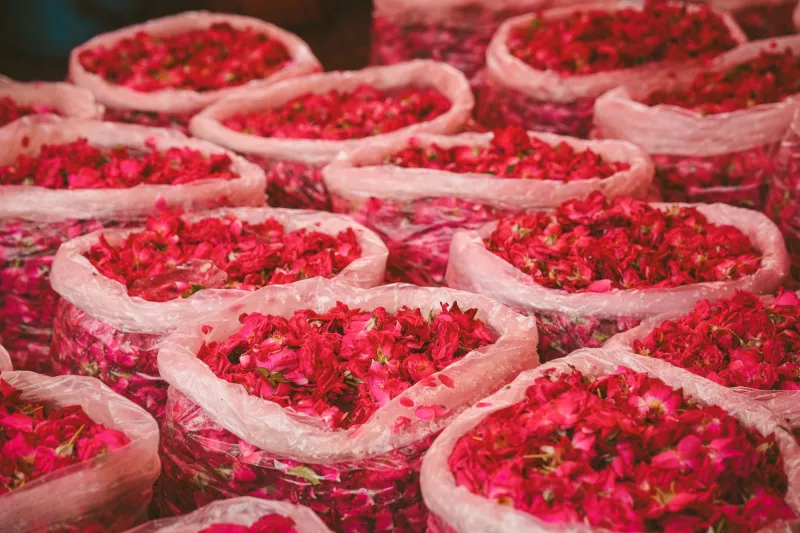
Bulgarian Rose. In the Rose Valley, centered around the town of Kazanlak, the damask rose bloom lasts only a few precious weeks in late spring. Flowers must be gathered in the early morning hours before the heat evaporates their delicate oils. It can take thousands of pounds of petals to produce a single pound of rose otto, which explains both its cost and its mystique. A perfume built on genuine Bulgarian rose carries a depth — honeyed, slightly spicy, faintly green — that synthetic approximations can suggest but never fully replicate.
California Orange Blossom. Closer to home for our American readers, orange blossom from California's citrus groves offers a luminous, sun-warmed brightness. The blossoms are typically harvested in spring when the oils are at their peak, then either distilled into neroli or extracted as an absolute with a richer, more rounded profile. Its character evokes the golden light of the Pacific coast — radiant, clean, and quietly romantic.
A Framework for Spotting the Genuine Article
With dupe culture flourishing across the American market, how can a fragrance enthusiast identify true artisanal work? We suggest four checkpoints:
- Named origins. If a brand lists simply "rose" or "woods," ask questions. Artisanal houses tend to name their sources — a specific valley, a named cooperative, a harvest year.
- Transparency about naturals and synthetics. Contrary to popular assumption, fine perfumery uses both. What matters is honesty. Reputable brands explain their choices rather than hiding behind vague marketing language.
- Batch size and release cadence. Limited batches, seasonal releases, and occasionally sold-out signatures are signs of a house working at a human scale.
- Evolution on the skin. Mass-produced fragrances often remain flat from first spray to drydown. A perfume built from quality materials unfolds — opening bright, revealing a heart, and settling into a base with genuine character.
The Reward of Patience
There is an understandable temptation to choose the inexpensive imitation, and no judgment attaches to that choice. But the difference between a standardized formula and a provenance-driven composition is the difference between a printed reproduction and an original painting. One decorates a room; the other changes it.
When you next lift a bottle to your wrist, consider the miles behind it: roots pulled from Haitian earth, petals gathered before sunrise in Bulgaria, blossoms warmed under a California sun. Every scent tells a story — and the finest perfumes ensure that story begins long before the first spray.